Four months after being released from prison in South Africa, Nelson Mandela toured the United States-- where welcoming committees were organized for each leg of his journey. One of my (typically unflappable) friends, Nasser, was lucky enough to find himself among the select few assigned to greet the human rights hero when he visited Boston, and over 20 years later Nasser still recalls “feeling like a kid who got to meet Superman in person!” when shaking Mandela’s hand for the first time.

But the man who embodied Dr. Martin Luther King, Jr.'s conviction that "The arc of the moral universe is long, but it bends toward justice” had to wait until his flight touched down at Metro Airport in Detroit before getting to meet his hero face-to-face.

The moment he emerged from the plane in Michigan, Mandela took in the gathering of politicians, dignitaries and VIP's waiting for him on the tarmac as he sought out the object of his admiration and affection. And then he spotted the petite woman seated in a wheelchair. Softy chanting her name: "Ro-sa Parks! Ro-sa Parks! Ro-sa Parks!"-- R’s trilling and tears rolling down his cheeks-- Mandela kept up the mantra until he reached her side, held her in his arms and confided, "You sustained me while I was in prison all those years."

Before hearing Douglas Brinkley tell this story at a book signing for his biography, Rosa Parks: A Life, 12 years ago, I’d always thought of his subject as a dignified little lady whose contribution to the struggle for civil rights began and ended the day she was simply too tired to give up her seat to a white man on a bus in Alabama.

I mistook Parks’s demure composure and diminutive frame for passiveness. I’d never contextualized the courage required for a black woman to stand up to a known bully-of-a-bus driver, James F. Blake, when he warned: "Y'all better make it easy on yourselves and let me have those seats.. if you don't stand up, I'm going to have to call the police and have you arrested." And I certainly never contemplated how swift and harsh the punishment might have been for Parks, not only to stand her ground that day, but to reply "You may do that,” to Blake, even as three other black passengers proximate to her immediately vacated their seats.

Such heroism cannot be overstated: particularly in an era when racism was institutionalized, retaliation for perceived slights (on the parts of blacks against whites) could manifest in punishments that ranged from harassment to lynchings, and law enforcement and the Ku Klux Klan were virtually indistinguishable entities in the Deep South. And yet, thanks to a series of holes in my education (the most stunning being the time my 10th grade American History teacher skipped an entire chapter, entitled Slavery-- which, sadly, encompassed the complete history of people of African descent in the United States and their contributions to society, according to the writers of this particular text book), and one iconic portrait of Parks that made her look like more of a bystander to history than one who actually shaped it, I was oblivious to her worldwide prominence as a mentor and comrade to giants of the human rights struggle.

According to the recently-published biography, "The Rebellious Life of Mrs. Rosa Parks" by Jeanne Theoharis, Parks's insistence upon fair play began in early childhood. Once reprimanded her for being "too high spirited" after she'd threatened a white boy with a brick because he'd taunted her-- Parks's grandmother openly feared that Rosa would be dead before she reached the age of 20; to which the little girl replied, "I would rather be lynched than run over by them." As a young woman, part of her attraction to Raymond Parks-- who she eventually married-- was because he was a civil rights activist who carried a gun and, according to Rosa, "refused to be intimidated by white people." And before sparking the Montgomery Bus Boycott that lasted 381 days, crippled the city's mass-transit system and resulted in a Supreme Court decision ordering Montgomery to integrate it's buses, Parks was secretary of her local NAACP chapter.

Given that backdrop, it's no wonder that warriors, like Mandela, looked up to the former seamstress who stood only 5’3” tall. But judging from the bronze statue of Parks that was recently unveiled in Statuary Hall at the Capitol Building in Washington, I fear that she may be remembered as a woman more willing to wait on change than initiate it.


Though the bronze statue stands nine feet tall and weighs 2700 pounds, Parks has been immortalized in a seated position which troubles me for many reasons. For starters, the pose diminishes her stature, relative to those of her peers throughout the Hall, when one might argue that she stood head and shoulders above all others where bravery and nobility were concerned. There's also the mythology of Parks having been too tired to give up her seat on that December day in 1955. In my mind, the statue literally cements a common misconception within the national psyche, in spite of Parks's having said, "I was not physically tired, or no more tired than I usually was at the end of a working day... No, the only tired I was was tired of giving in."

As for the expression of resignation on Park's face, it substantiates Theoharis's claim that Parks's legacy has been sugarcoated to emphasize her “quiet, humble and soft-spoken” nature to the exclusion “of her lifelong history of activism and anger at American injustice.” Ditto where her ladylike posture, crossed ankles and averted gaze are concerned. As for the little purse perched upon her lap-- that kooky touch strikes me as more befitting a statue of the Queen of England than that of a woman who could not have come into this world more disadvantaged and disenfranchised than a black girl born in Tuskegee, Alabama 50 years after the Emancipation Proclamation was issued.

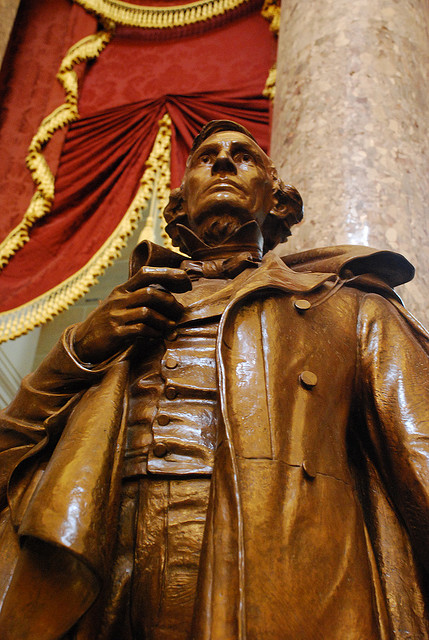
I don't see the justice in having Mrs. Parks's sweet visage look upon that of Jefferson Davis's (who is positioned directly opposite her in the Hall) for perpetuity, either-- with his chin-up/shoulders-back posture as if he were some paragon of bravery, nobility and morality when, in fact, he was president of the Confederacy during the Civil War. And how ironic that the woman who helped make this nation live up to its credo, that all men are created equal, should appear grounded by the rock from which she rises.
For all my nitpicking, there is no doubt in my mind that the statue of Rosa Parks-- designed by Robert Firmin and sculptured by Eugene Daub-- was rendered with tremendous love and respect. Firmin has stated that his decision not to portray Parks sitting on a bus seat was deliberate because, “that choice would trivialize things.” Adding, “it’s about her, not about a bus.”

But the more I look at the statue, the more certain I am that this is really about us. It's about our failure to properly assess the true measure of a mighty heart. It's about our ignorance of every American's history in the United States. It's about a double-standard: that makes us inclined to elevate those who turn the other cheek when attacked... especially if they are female or people of color... and lionize those who kick ass when we perceive a threat to the nation's freedom and liberty. And it's about our inability to embrace all facets of the Mother of the Civil Rights Movements.

As Jesse Jackson said during last week's unveiling, “She was not a meek woman... she meant to make something happen.”

And given the price she paid for all our sakes, perhaps the least we can do in return is put aside any one-dimensional ideas about this American icon, and finally allow the real Rosa Parks to stand up.